When people think about attic insulation, they think about R-value — how much, how deep, how warm. In a lot of Oakville homes, that’s only half the story.
The other half is moisture. A damp attic, frost on the underside of the roof sheathing in winter, a faint musty smell upstairs, dark staining on the plywood, insulation that looks matted or discoloured — these are moisture problems, and they’re common enough in Oakville’s housing that they deserve as much attention as the R-value number.
Here’s what’s happening up there, why it matters, and why insulation and moisture have to be solved together.
Why moisture, and why Oakville
An attic is supposed to stay cold and dry in winter. Two things conspire against that:
Warm, humid air rising from the house. Your home generates a lot of moisture — cooking, showers, laundry, people breathing. That humid air rises, and if the ceiling isn’t well sealed, it leaks into the attic.
A cold surface for it to condense on. The underside of the roof sheathing in January is cold. When warm humid air meets it, the moisture condenses — as damp, frost, or ice. When it thaws, it drips onto the insulation and the ceiling below.
Oakville adds a few local factors that tilt the odds:
- Lakeshore humidity. Proximity to Lake Ontario means higher ambient humidity through parts of the year, and more moisture in the air the attic has to manage.
- Mature tree canopy. Oakville’s older neighbourhoods are heavily treed. Shaded roofs stay cooler and damp longer, and overhanging limbs drop debris that clogs soffit and gutter airflow.
- Larger, tighter homes. Bigger Oakville homes generate more interior moisture, and a tighter building envelope gives it fewer places to escape except upward.
None of this means your attic has a moisture problem. It means moisture is worth checking properly — because insulating over a moisture problem makes it worse, not better.
How to check your attic for moisture — carefully
When to look: a cold morning in winter is most revealing, because that’s when condensation and frost show up.
- Open the hatch, shine a strong light, step only on joists
- Look at the underside of the roof sheathing (the plywood or board above the rafters):
- Dark grey or black staining
- Frost or ice crystals on a cold day
- Water droplets or damp-looking wood
- White, fuzzy, or discoloured patches
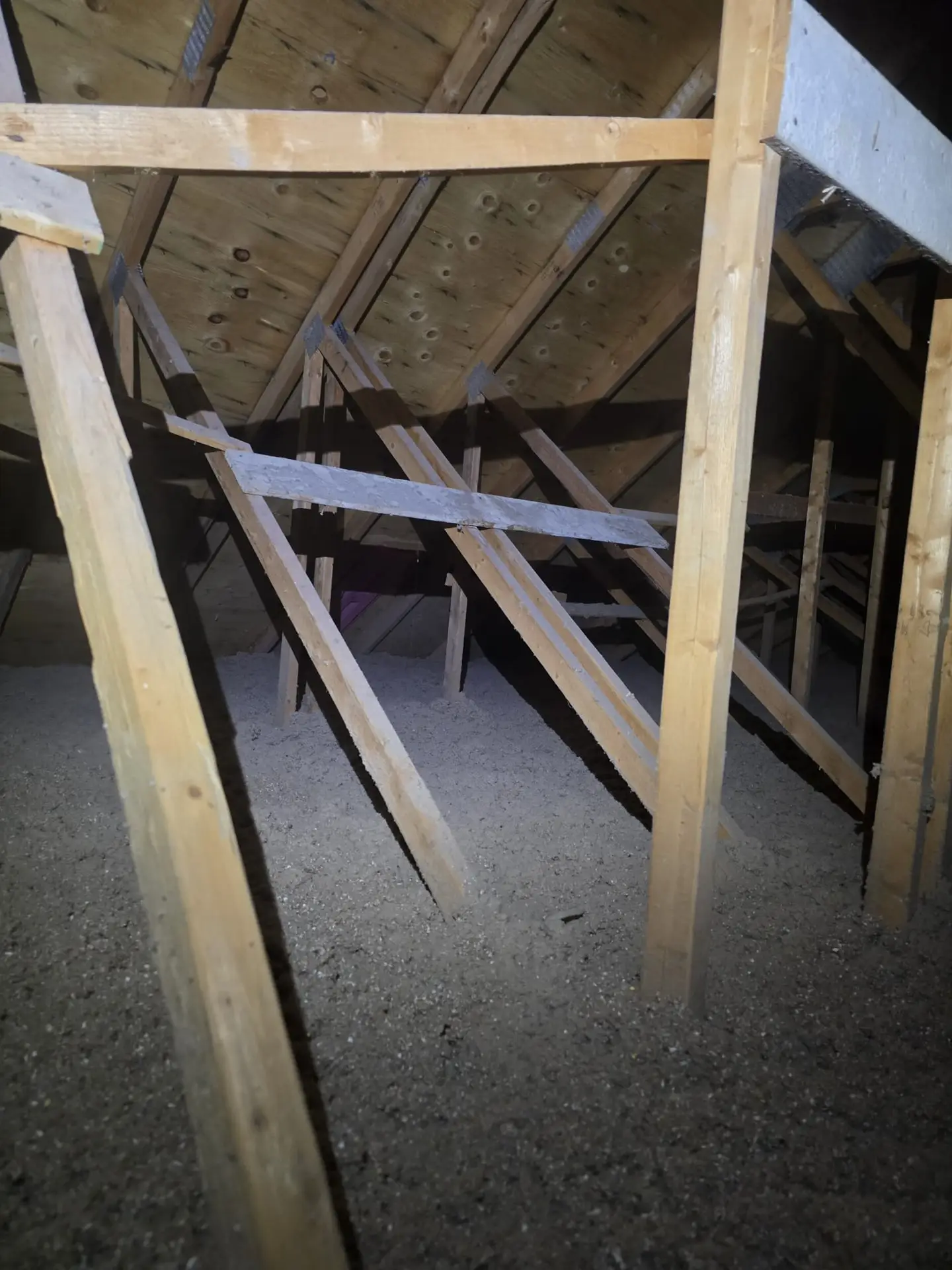
- Look at the insulation: matted, compressed, discoloured or damp-looking areas, especially near the eaves or under roof penetrations
- Check for daylight and airflow at the eaves — you should have soffit intake, not insulation packed against the roof
- Note any smell — a musty or earthy odour suggests trapped moisture
⚠️ If you see extensive dark staining, fuzzy growth, or a strong musty smell, don’t disturb it and don’t try to treat it yourself. Attic mould needs proper assessment. Wiping or spraying it, or blowing new insulation over it, can spread the problem and hide it. Get it looked at before any insulation work proceeds.
The R-value question still matters — measure it too
Moisture is the under-discussed half. R-value is still the other half, so while you’re up there:
- Push a ruler to the drywall at several spots, including near the eaves
- Convert:
| Material | R per inch | 8 in | 12 in | 16 in |
|---|---|---|---|---|
| Blown cellulose | ~3.4 – 3.8 | ~R-28 | ~R-42 | ~R-56 |
| Blown fibreglass | ~2.7 – 3.0 | ~R-22 | ~R-34 | ~R-45 |
| Settled batts | ~2.5 – 3.2 | ~R-22 | — | — |
Target: R-50 minimum to protect rebate eligibility, R-60 where there’s headroom.
But here’s the key point: if there’s a moisture problem, the R-value work waits. You fix the source of the moisture first, then insulate. Otherwise you’re burying the problem.
The three things that actually control attic moisture
1. Air sealing the ceiling — stops moisture at the source
Most attic moisture arrives as humid indoor air leaking up through gaps in the ceiling: the attic hatch, plumbing stacks, wiring penetrations, the tops of interior walls, and exhaust-fan housings. Air sealing these closes the door on the moisture before it reaches the cold attic.
This is why air sealing comes before insulating — seal the leaks, then insulate. Blow loose fill over an unsealed ceiling and the humid air still gets through; you’ve just hidden where. Vapour barrier installation →
2. Ventilation — carries away what does get through
A properly ventilated attic moves air continuously: cold dry air enters low at the soffits, moist air exits high at the ridge. That airflow keeps the sheathing cold and dry and carries away any moisture that gets past the air sealing.
Blown-in insulation buries soffit vents unless baffles hold it back. Blocked soffits are one of the most common causes of attic moisture in Oakville’s treed, older neighbourhoods — leaves and debris clog what airflow there is, and packed insulation finishes the job. Baffles go in before the insulation. Baffle installation →
3. Bathroom and kitchen fans vented to the outside — not the attic
This is the single most common moisture source we find, and it’s remarkably widespread: an exhaust fan that discharges into the attic instead of through the roof or wall to outside. Every shower, all winter, pumping humid air directly onto cold sheathing.
Any insulation installed over that gets wet. The duct has to run all the way to the exterior — not just to the attic space — before insulating.
When moisture has already done damage: removal first
If the existing insulation is wet, matted, mouldy, or contaminated, topping up over it doesn’t work. It has to come out first.
Removal is the right call when there’s:
- Mould or mildew in the insulation or on the sheathing (assessed properly first)
- Water damage from roof leaks or fan venting
- Rodent contamination — droppings and nesting
- Long-term dampness that’s compressed and degraded the material
Once the material is out, the source is fixed, and the sheathing is dry and sound, new insulation goes in over a clean, dry, properly ventilated attic. Attic insulation removal →
What a proper job looks like in a moisture-prone attic
- Assess — R-value and moisture: sheathing condition, insulation condition, ventilation, fan venting, penetrations
- Identify and fix the moisture source — fan venting, air leaks, ventilation deficits, any roof leak (roofer if needed)
- Remove contaminated or water-damaged material
- Air seal the ceiling plane
- Confirm soffit intake and install baffles — restore the airflow
- Insulate and weatherstrip the hatch
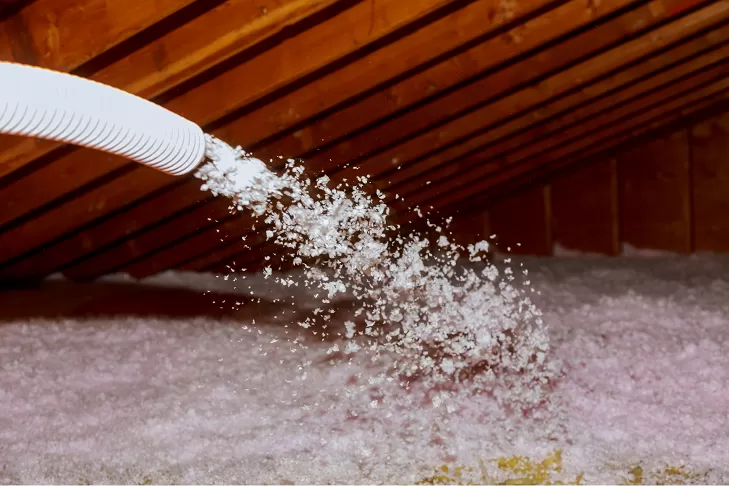
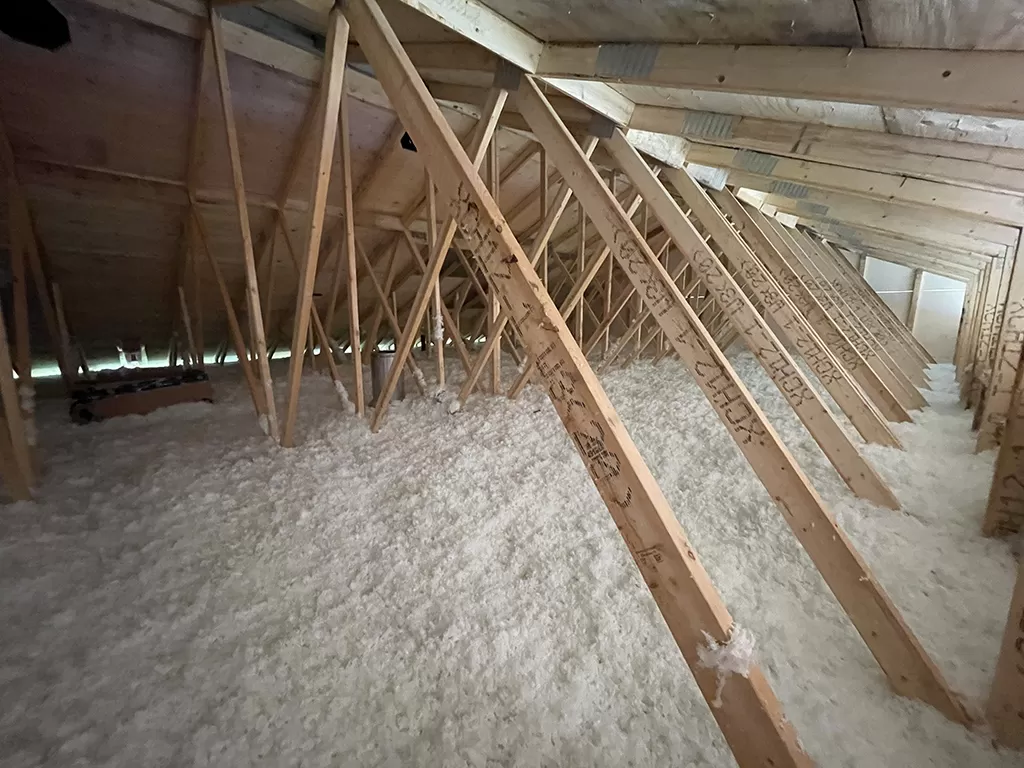
- Blow to depth, out to the eaves — R-50 minimum, R-60 target
- Mark depths so the result is verifiable
On material: cellulose is denser and better at slowing air (and therefore moisture) movement, which suits a moisture-conscious job; fibreglass is lighter and often the cheaper route to the same R-value. Both are rebate-eligible. The bigger decision here isn’t the material — it’s making sure the moisture strategy is right first.
Cellulose blown-in → · Fibreglass blown-in →
The cold room over the garage — a different issue
Common in Oakville’s larger homes, and worth separating out: a cold room above the garage isn’t an attic or a moisture problem. That floor sits over an unheated garage, and the fix is closed-cell foam in the garage ceiling, not attic work. Garage ceiling insulation →
Frequently asked questions
Why is there frost on the wood in my attic? Warm, humid indoor air is leaking into the attic and condensing (then freezing) on the cold roof sheathing. It points to an air sealing and/or ventilation problem, not just an insulation one.
Is attic mould dangerous? Any suspected mould should be assessed properly rather than diagnosed from a distance or treated by a homeowner. Don’t disturb it, and don’t insulate over it — have it looked at first.
Will adding insulation fix my damp attic? On its own, usually not — and it can make it worse by making the attic colder. The moisture source (air leaks, ventilation, fan venting) has to be fixed first, then insulation added.
Why does my upstairs smell musty? A musty smell often signals trapped moisture in the attic. Worth having the attic assessed for condensation, ventilation and any growth.
Do I need to remove my old insulation? Only if it’s wet, mouldy, rodent-contaminated, or degraded. Clean, dry insulation can be topped up and the R-values add.
Do I have to leave home during the work? No.
How long does it take? A straightforward top-up is usually a day. Moisture remediation, removal or ventilation fixes extend it — which is why the assessment comes first.
Get the moisture checked, not just the depth
In Oakville, a good attic assessment looks at two things: how much insulation you have, and whether moisture and airflow are under control. Miss the second and even a perfect R-60 can sit over a problem.
Pro Insulation Contracting has insulated Ontario homes for over 10 years and serves Oakville and the surrounding area. Free on-site assessment covering R-value, ventilation, fan venting and moisture — with a written scope and fixed price, and an honest word if something needs a roofer or a proper mould assessment before we insulate.
📞 (416) 315-0471 · Book a free attic assessment →