Old Oakville’s historic core, Bronte, Kerr Village and the lakeshore’s older streets have some of the most beautiful housing in the GTA. They’re also some of the hardest to insulate — plaster walls you can’t open without destroying them, 1½-storey rooflines with awkward knee walls, dormered bedrooms that are always cold, and sometimes heritage designations that limit what you can touch.
The good news: most of these homes can be made dramatically more comfortable. The key is knowing where spray foam fits within the constraints of a house you can’t gut — and where a different approach serves you better.
The core constraint: you can’t just open everything up
In a new build or a full gut renovation, you insulate by opening the walls, filling the cavities, and closing them back up. In an occupied heritage or older Oakville home, that’s often off the table — the plaster is original, the trim is irreplaceable, the exterior may be protected, and you’re living there.
So the question isn’t “what’s the theoretically best insulation.” It’s “what’s the best insulation we can install given what we’re allowed to open.” That reframes everything below.
The two products, briefly
| ½ lb open-cell | 2 lb closed-cell | |
|---|---|---|
| Approx. R per inch | ~R-3.5 – R-3.8 | ~R-6.0 – R-7.0 |
| Structure | Soft, flexible | Rigid, dense |
| Own vapour barrier? | No | Yes, at sufficient thickness |
| Moisture | Absorbs water | Resists water |
| Sound dampening | Better | Poorer |
| Cost | Lower | Higher |
In older homes, closed-cell does most of the heavy lifting where cavities are shallow or exposed to exterior conditions, because its high R-per-inch matters when depth is limited. But the older the house, the more moisture behaviour matters — which is where care comes in.
½ lb open-cell → · 2 lb closed-cell →
Where spray foam fits in an older Oakville home
1. The 1½-storey knee walls and sloped ceilings
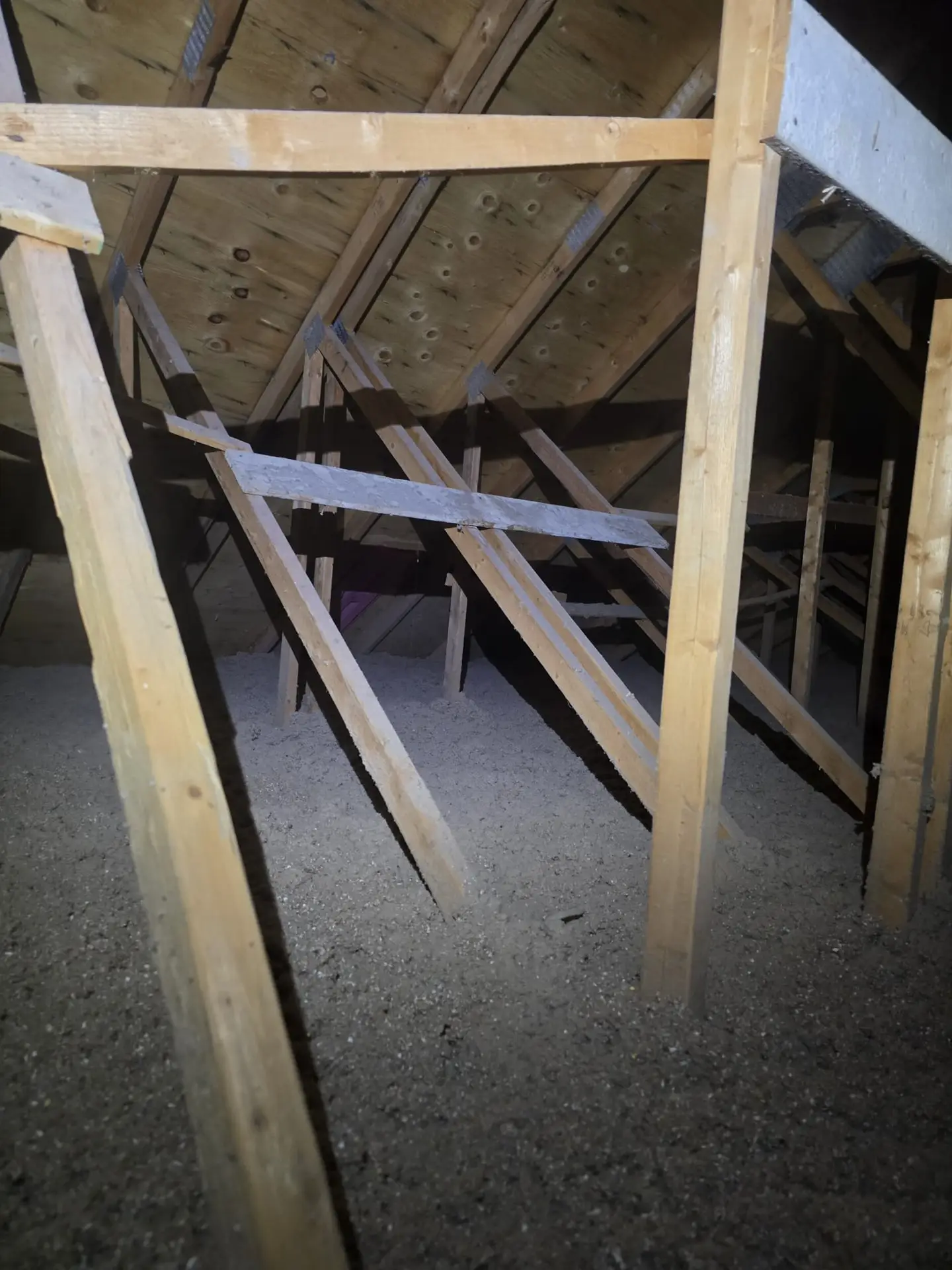
This is the signature problem of Old Oakville’s storey-and-a-half homes. The upstairs bedrooms have sloped ceilings following the roofline and short vertical knee walls where the ceiling meets the floor, with triangular void spaces behind them.
These homes are notoriously hard to heat upstairs because:
- The sloped-ceiling cavities are shallow — little room for insulation
- The knee-wall voids behind the short walls are often uninsulated and open to attic air
- Air moves freely through the whole assembly
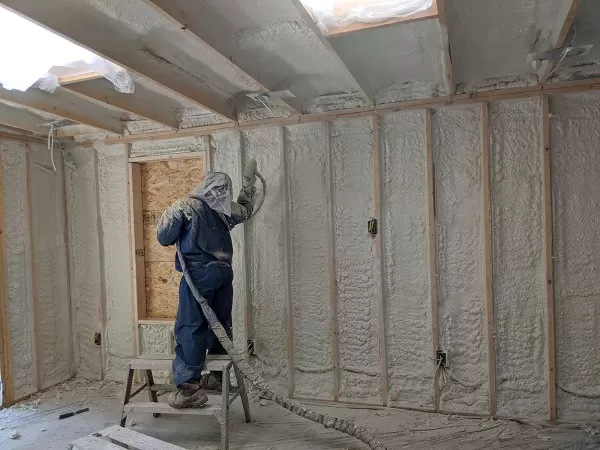
Where foam helps: closed-cell in the shallow sloped-ceiling cavities delivers more R-value per inch than anything else, and sealing the knee-wall voids and the floor at their base stops the air movement that makes these rooms cold. It’s often the single biggest comfort improvement available in a 1½-storey house.
2. Rim joists and the basement perimeter
Older Oakville basements have the same continuous rim-joist air leak as any house, usually with nothing in it. Closed-cell foam seals and insulates it in one pass — small area, big effect on a draughty old first floor. It’s also a low-cost qualifying rebate measure ($300 on the bundled path).
Where basements are being carefully finished (common in these homes), closed-cell on the foundation wall insulates and controls vapour together, keeping framing dry — important in an older basement that may manage moisture differently than a modern one. Vapour barrier installation →
3. Dormers
Old Oakville homes are full of dormers, and each one is a little box of exterior surface — cheeks, roof, and a small ceiling — poking out of the roof. They’re a common cold spot and a common leak point. Where accessible, foam seals and insulates the dormer assembly far better than trying to fit batts into its awkward corners.
4. The garage ceiling / room above
Where an older home has an attached or converted garage with space above, the cold-floor fix is the same as anywhere: closed-cell in the garage ceiling. Garage ceiling insulation →
When the walls can’t be opened: drill and fill, not foam
Here’s the honest part. For the main walls of a heritage or older Oakville home — the big plaster-and-lath exterior walls that are usually uninsulated — spray foam is often not the answer, because you can’t open the wall to spray it and you can’t spray into a closed cavity.
The right tool there is usually drill and fill: small holes are drilled (from the interior or, where the exterior isn’t protected, from outside), insulation is blown into the wall cavity, and the holes are patched. It insulates the wall without opening it up.
This matters for two reasons in Oakville specifically:
- On a heritage-designated home, you may be restricted from altering the exterior, which affects whether drilling happens inside or out — a question for the assessment and, where applicable, the Town’s heritage rules.
- Older plaster-and-lath walls and their moisture behaviour need to be understood before filling — the wrong approach in an old wall can trap moisture.
Drill and fill for older walls →
💡 If your home is heritage-designated, treat any exterior-affecting work as a permissions question first. We’ll tell you what’s possible from the inside; anything touching a protected exterior is between you and the Town’s heritage process.
The heritage moisture caution
Older homes were often built to manage moisture by breathing — moisture moves through the assembly and dries out. Aggressively air-sealing and foam-encapsulating parts of an old house can change that behaviour, and done without thought it can trap moisture where it used to escape.
This doesn’t mean “don’t insulate old homes” — it means the moisture strategy has to be considered, not assumed. A good assessment on an older Oakville home looks at how the existing assembly handles moisture before deciding where foam is appropriate and where a more vapour-open approach is safer.
Be cautious of anyone who wants to foam-encapsulate an old house without discussing how it currently manages moisture. In a heritage home, that conversation isn’t optional.
Where foam isn’t worth it — older-home edition
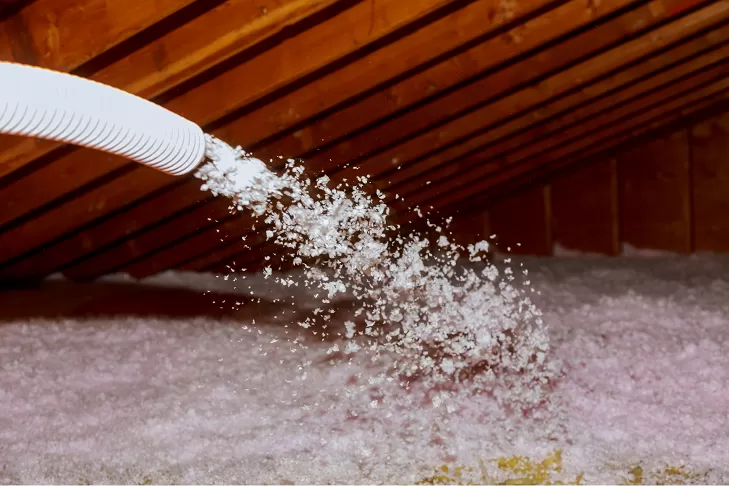
A standard attic, if the home has one with headroom — blown-in reaches R-60 for less. Many older Oakville homes have complicated or shallow attics, but where there’s a proper accessible attic, blown-in wins on cost. Attic insulation in Oakville →
Interior walls where you only want quiet — a home theatre or study — where acoustic mineral wool does sound better and cheaper. Safe and Sound →
The main exterior walls, as covered above — drill and fill, not foam, when you can’t open them.
Over an unresolved moisture problem — fix the source first, in an old house especially.
Practical questions
My house is heritage-designated. Can you still insulate it? Usually yes — interior work and attic work are typically unaffected by exterior heritage designation. Anything that alters a protected exterior is subject to the Town’s heritage rules, which we’ll flag. We work within what’s permitted.
Do I need to leave during installation? We install Insulthane Extreme by Elastochem and residents can generally remain in the home. We’ll discuss ventilation and re-entry for the specific area, and flag any respiratory sensitivities in advance.
Will foam damage my old plaster? We don’t spray into closed plaster walls — that’s what drill and fill is for. Where we do apply foam (knee walls, rim joists, dormers, basement), it’s on exposed framing, not against finished plaster.
Is spray foam safe in an old house? In the right locations, yes. The caution is about moisture strategy in the overall assembly, which is why assessment comes first rather than a blanket approach.
Can foam be removed later? Not easily — it bonds permanently. A reason for care in a home you want to preserve.
Does this qualify for rebates? Knee-wall/sloped-ceiling, basement wall, rim joist and drill-and-fill wall work can each qualify under the program depending on the measure and R-values achieved. Oakville rebate details →
⚠️ Program terms change — confirm at homerenovationsavings.ca.
How we quote an older home
- On-site assessment — what can be opened, what can’t, how the assembly handles moisture, and where foam versus drill-and-fill versus blown-in makes sense. Heritage constraints flagged.
- Product and thickness specified per assembly — so bids are comparable and the vapour strategy is deliberate.
- Fixed price, up front.
- Honest routing — if the walls need drill-and-fill rather than foam, or a moisture question needs resolving first, we say so. We install foam, drill-and-fill, blown-in, batt and mineral wool.
📞 (416) 315-0471 · Book a free assessment →